
TL;DR
Microsoft just added Anthropic’s Claude models to Microsoft Foundry.
Instead of reading the press release, I ran a mini-benchmark to see how Claude Opus, Sonnet, and Haiku actually perform with real Python tasks and stdin/stdout workflows.
The results will surprise you.
Opus was the most complete, Haiku the fastest (and chattiest), and instruction-following was the weak point across the board.
If you’re thinking about using Claude in production, read this first.

Skip the Hype: What Engineers Actually Need to Know
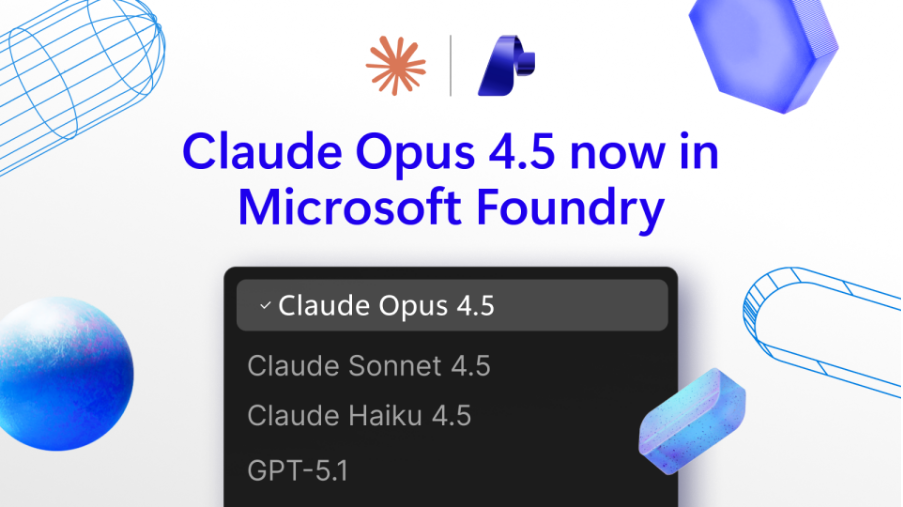
Microsoft’s announcement “Introducing Anthropic’s Claude models in Microsoft Foundry”.
This means that Claude models are now available inside an Azure-native surface.
Sounds promising, but I’m not interested in marketing press releases.
I care about whether this actually works in pipelines today.
As an Azure engineer, I translate announcements like this into simpler questions:
- Where’s the endpoint?
- Which SDK do I use?
- Will the model behave when my pipeline feeds it stdin instead of poetry prompts?
So instead of opening a slide deck, I opened a terminal.
.
Why I Built a Mini Benchmark Instead of Reading the Docs
When new models land in a production environment, the first question isn’t “Which model is smartest?” It’s:
- How fast is it?
- Does it follow instructions?
- Will it break our workflows?
I didn’t want another big benchmarking suite. I needed a quick, cheap, repeatable way to smoke test real behavior. That’s where Mini-5 comes in.
The Mini-5: Five Python Tasks That Expose Real Integration Flaws
These aren’t clever coding challenges. They’re boring on purpose.
Here’s what I threw at the models:
- p95(values): Percentile logic with edge-case ambiguity
- unique(seq): Deduplicate while preserving order
- Read JSON from stdin ({service, latency}), return average latency per service
- top3(data): Return three keys with the highest values
- Read CSV from stdin, return structured JSON
These tasks test ambiguity, instruction compliance, data plumbing, and output discipline, all critical in real workflows.
The Test Setup: Same Settings, No Shortcuts
I ran all three Claude variants in Microsoft Foundry:
- Claude Haiku 4.5
- Claude Sonnet 4.5
- Claude Opus 4.5
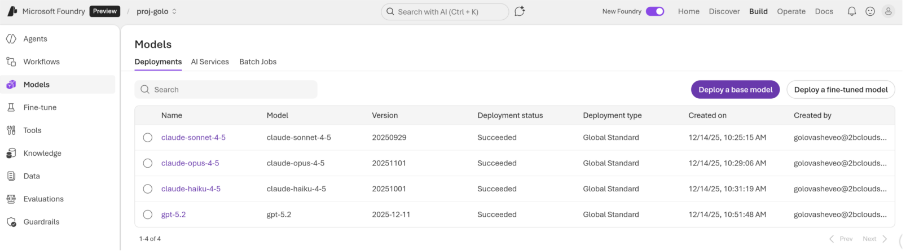
With these consistent settings:
- Temperature: 0
- Streaming: enabled
- Wall-clock execution time measured
- Input/output tokens recorded
- Model token limits respected
Everything was saved as structured JSON and summarized in Markdown.
GPT-5.2 as the Judge: Because Output Discipline Matters
You can’t trust latency alone. A fast model that adds Markdown, commentary, or logging noise will break a production pipeline.
To score consistently, I used GPT-5.2 as an automated judge:
- Analytical summary per task
- Scores for correctness, instruction-following, code quality, robustness
- Normalized data for reporting
This kept evaluation deterministic and machine-readable.
Results: What Each Claude Model Did Right (and Wrong)
Benchmark Results
| Model | Time (s) | Input Tokens | Output Tokens | Total Tokens |
| claude-sonnet-4-5 | 7.754 | 183 | 429 | 612 |
| claude-opus-4-5 | 8.226 | 183 | 528 | 711 |
| claude-haiku-4-5 | 5.404 | 183 | 903 | 1086 |
What stands out:
- Haiku is the fastest, but produces the most output tokens.
- Sonnet sits in the middle, both in latency and verbosity.
- Opus is the slowest, but generates the most complete solution shapes.
Evaluator Results (GPT-5.2)
| Model | Correctness | Instructions | Code Quality | Robustness | Summary |
| Sonnet 4.5 | 2 | 2 | 3 | 2 | Missing executable stdin path and incorrect p95 semantics. |
| Opus 4.5 | 4 | 2 | 4 | 3 | Functionally complete, but breaks “code only” constraints. |
| Haiku 4.5 | 2 | 1 | 3 | 2 | Incorrect p95 and test output printed to stdout. |
What These Results Really Mean for Engineering Teams
This isn’t a leaderboard, it’s a reality check:
- Instruction-following is the weak point across the board. That’s the failure mode that breaks pipelines.
- Haiku is fast but over-generates without tight prompt control.
- Sonnet looks reasonable but isn’t safe for automation without orchestration.
- Opus gives the best structure, but you still need output constraints.
When the model output is executed directly, “code only” isn’t a suggestion. It’s an engineering contract.
Pricing Reality Check: Easy to Verify in Foundry
Pricing is available directly in Microsoft Foundry:
Just pick a Claude model, open the pricing tab, and compare. You can test behavior and cost side-by-side in seconds.
What This Test Is (and Isn’t)
Mini-5 is:
- A quick, low-cost smoke test for practical model behavior
- Designed to reveal obvious integration risks early
Mini-5 is not:
- A comprehensive benchmark
- A replacement for full integration testing
- A substitute for code review
Use it to inform early decisions, not to finalize them.
Final Takeaway: Don’t Wait for the Deck. Open a Terminal.
Claude models are now in Azure Foundry, which means faster testing using the tooling and governance you’re already using.
When a new model hits your cloud, don’t waste time debating.
- Run a quick benchmark
- Measure latency
- Count tokens
- Inspect outputs
- Apply consistent evaluation
One fast test won’t answer every question. But it will show you whether it’s worth asking the next one.
____________________________________
— Looking to explore further?
Check out the full Microsoft announcement
— Need help running your own tests?
Evgeniy Golovashev, 2bcloud
Solution Architect